How Paper Grade Affects Cutting Performance | Practical Guide

Not all paper behaves the same in a sheeter.
Running different grades with one fixed setup is one of the most common reasons for defects, unstable operation, and unnecessary downtime.

In real production, cutting performance is closely tied to the physical properties of the paper—weight, stiffness, surface structure, and moisture behavior all play a role. Ignoring these differences leads to inconsistent results.

Why Paper Grade Matters

Each paper grade responds differently to tension, cutting force, and transport conditions.

A setup that works well for one material may cause problems for another.
This is why parameter adjustment is not optional—it is necessary for stable production.

Typical Behavior by Paper Type

1. Lightweight Paper (28–80 gsm)
Thin paper is flexible and highly sensitive to tension changes.

Common issues include:

  • wrinkling during transport
  • web instability at higher speeds
  • risk of web breaks under excessive tension

To run lightweight grades properly, the system must operate under low, stable tension, with smooth conveying and minimal disturbance.

2. Heavy Board and High GSM Paper
Thicker materials behave very differently.

They require:

  • higher and more stable cutting force
  • rigid mechanical support during cutting
  • precise synchronization to avoid deformation

If the cutting force is insufficient or unstable, problems such as rough edges or incomplete cuts can occur.

3. Coated Paper
Coated surfaces introduce another layer of complexity.

While structurally stable, they are more sensitive to surface damage.

Typical risks include:

  • scratching during transport
  • coating cracks at the cut edge
  • visi

Why Your Sheeter Never Reaches Rated Speed | SMH Solution

workshops, most sheeters are labeled with impressive top speeds, but very few actually run at those levels day in and day out. The problem is almost never the main machine itself—it’s the small, unbalanced details holding the whole line back.

From our years of on-site experience with hundreds of paper mills, we’ve narrowed it down to three most common bottlenecks:

  1. Tension instability: When tension jumps up and down, operators have no choice but to lower speed to stop paper from wrinkling, stretching, or even breaking.
  1. Edge guiding delay: At high running speeds, even tiny deviations in edge position become obvious quickly, forcing the line to slow down for correction.
  2. Transport mismatch: If the conveyor, stacking, or downstream packing can’t keep up with the cutter, the whole line has to throttle back to avoid jams.

Running at full rated speed isn’t about forcing the machine harder. It’s about system balance. SMH designs sheeters with stable tension control, precise edge guiding, and fully synchronized conveying and stacking systems, so your production line can hold rated speed steadily for long runs.

SHM A4-5 & A4B Line Installed in Tanzania

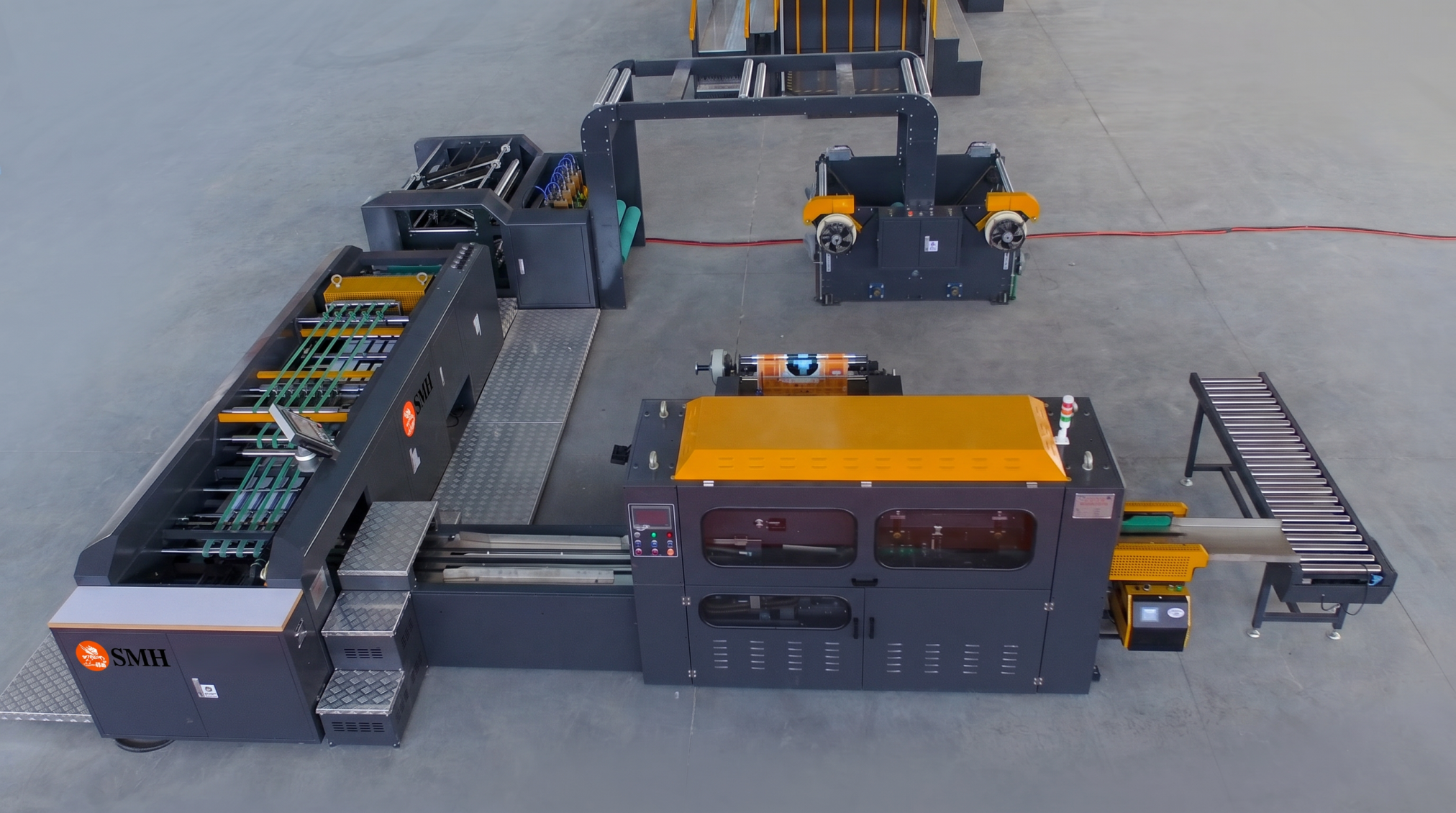
A new A4 paper production line featuring the SMH A4-5 sheeter and A4B packing machine has recently been installed and commissioned in Tanzania. The project marks a practical step for the local converter, moving from basic supply toward integrated, in-house processing.

From Manual to Continuous Production

Before the upgrade, the factory relied heavily on semi-manual operations. Cutting speed was limited, packing consistency varied, and output depended on labor coordination.

Now, with the A4-5 and A4B running, the workflow is stable and continuous. Jumbo rolls convert directly into A4 sheets, then automatically counted and packed. Output stays consistent across shifts, with less manual intervention and better predictability.

Why A4-5 Was Selected

The factory chose the A4-5 to meet rising demand and support future growth. Its wider web handling and higher cutting capacity allow more paper processed in the same time.

Key benefits in daily operation:

  • Stable cutting accuracy at continuous speed
  • Consistent sheet size across large volumes
  • Less material waste from better control

For a market where both volume and reliability matter, these give a clear edge.

Packing Stability with A4B

The A4B packing machine solves a common bottleneck: end-of-line handling. Instead of manual counting and wrapping, the system delivers uniform ream packaging, stable sealing, and synchronized output with the sheeter. Finished products are ready for shipment without rework or delay.

Adapted to Local Conditions

The Tanzania installation was configured with three practical considerations:

  • Compatibility with local paper grades
  • Stable performance under variable power conditions
  • Simplified operation for local teams

SMH engineers supported installation and operator training, so the line ran reliably from the start.

Operational Impact

Since commissioning, the factory reports:

  • Higher daily output with fewer interruptions
  • More consistent product quality
  • Reduced dependence on manual labor
  • Better ability to handle bulk and repeat orders

The business no longer limits itself to trading or basic processing – it now controls a larger part of the value chain.

Conclusion

The A4-5 and A4B installation in Tanzania reflects a broader shift: moving from manual, fragmented operations to integrated, automated production. By stabilizing both cutting and packing, the line provides not only higher capacity but also the consistency needed to compete in a growing market.

Need to upgrade your A4 line?

If you’re planning to move toward in-house A4 converting, SMH can help design a solution based on your actual production conditions.

Contact SMH to evaluate your line setup and improve output stability.

What Causes Paper Dust During Cutting & How to Reduce It

Keywords: paper dust problem, cutting quality, knife conditionPaper dust is one of those issues many factories ignore until it’s too late. It builds up in motors, sensors, and gearboxes, shortens maintenance cycles, and leaves messy edges on finished sheets—directly hurting product quality and customer satisfaction.

From our on-site observations, paper dust almost always comes from three root causes:

  • Worn or blunt knives: Instead of making clean cuts, dull blades tear paper fibers, creating a lot of fine dust.
  • Wrong cutting angle or pressure: Too much friction during cutting heats the paper and breaks fibers unnecessarily.
  • Over-dry paper: Paper that’s too low in moisture becomes brittle and sheds dust easily when cut at high speed.

Controlling dust isn’t just about cleaning the machine more often. SMH uses precision-ground blades, optimized cutting geometry, and stable running parameters to minimize fiber tearing at the source, giving you cleaner cuts, less dust, and higher material yield.